
Schemes and policies for design students refer to government-led initiatives that provide financial support, skill development opportunities, startup assistance, and institutional reforms aimed at strengthening creative education in India, especially across leading fashion design institutes. Under Union Budget 2026, the focus has shifted toward infrastructure expansion, creative economy integration, and skill-based development rather than direct tuition subsidies.
These initiatives aim to:
- Improve access to creative education
- Strengthen industry-linked training
- Support innovation and entrepreneurship
- Expand institutional infrastructure
While there are limited new direct government schemes for design students announced in Union Budget 2026, the broader framework of support signals long-term structural reform. The emphasis is on ecosystem development rather than standalone scholarships.
Why Design Students Need Government Support?
Design education in India involves studio infrastructure, software tools, material exploration, and production exposure, making it more resource-intensive than many academic streams. Tuition fees across premier institutions remain high, especially in private design schools and leading fashion designing colleges in Delhi NCR. This makes government policies for design students essential to maintain access and equity.
India’s creative economy is expanding through AVGC (Animation, Visual Effects, Gaming, Comics), fashion exports, industrial design, and startup ecosystems. However, a visible skill gap exists between academic training and industry expectations. Structured design education support becomes critical to ensure students are employable at a global level.
Global competitiveness also requires consistent policy backing. Countries investing in creative industries are positioning design as an economic driver. Without long-term public policy alignment, Indian design graduates risk limited exposure in international markets. Budget-linked reforms therefore play a strategic role beyond just financial aid.
Key Schemes and Policies for Design Students Announced in Union Budget 2026
Financial Assistance and Funding Support
Union Budget 2026 prioritises skill infrastructure, creative economy expansion, and industry-linked education reforms. While no new direct tuition subsidies were announced for design programmes, several existing financial support mechanisms continue to benefit design aspirants.
Ongoing financial support includes:
- NID Merit Awards – ₹50,000 financial recognition for top entrance rank holders
- Merit-cum-Means Scholarships – ₹30,000-₹50,000 support for EWS students in the top academic percentile
- NIFT Post-Matric Scholarships – SC/ST financial aid administered via National Scholarship Portal
- Institutional Fee Waivers – income-linked tuition concessions for families earning below ₹2-8 lakh annually
- Sarthak Scheme – up to 75% tuition waiver for eligible postgraduate design students
These programs function as indirect financial aid for design students, ensuring access remains partially income-sensitive despite the absence of fresh Budget 2026-specific tuition grants.
Skill Development and Industry Integration
A major thrust of Union Budget 2026 lies in skill expansion rather than direct scholarships. Through skill ministry allocations and AVGC creator labs in 15,000 schools and 500 colleges, the government aims to bridge academic-industry gaps.
These government schemes for design students focus on:
- Industry-aligned curriculum updates
- Mandatory internship exposure
- Digital manufacturing and AI literacy
- Technical textile and creative cluster training
Budget support toward PM-SETU and ITI strengthening signals broader skill development policies that indirectly benefit design disciplines, especially in technical design, animation, applied arts, and expanding opportunities for designers in textile industry through vocational training, digital fabrication exposure, and industry-aligned skill programmes.
Get Started Today: Our Counselors are Just a Click Away
Startup and Entrepreneurship Support
Union Budget 2026 continues to promote the “Orange Economy,” recognizing creative industries as drivers of economic growth. This extends government support for designers who wish to build independent studios or creative startups.
Key mechanisms include:
- Startup incubation centers
- Innovation-linked grants
- Access to credit via national startup frameworks
- Creative cluster funding
These evolving schemes and policies for design students encourage self-employment rather than sole reliance on placement-based careers. The shift supports young designers entering fashion labels, product startups, craft-based enterprises, and digital creative platforms.
Institutional and Policy Reforms
Infrastructure development remains a core highlight. The announcement of a new NID campus in eastern India and expansion of AVGC labs strengthens long-term design capacity, while exposure to emerging technologies and awareness of the top 10 AI tools for creative production are increasingly being integrated into institutional ecosystems.
At a broader level, the national design policy framework continues to influence institutional modernization. While national design policy India has not been newly revised under Union Budget 2026, its objectives – innovation, IP development, and global competitiveness – remain central to reform discussions.
Curriculum modernization, research grants, infrastructure funding, and technology adoption trends reflect a systemic design policy direction rather than isolated financial interventions. These government policies for design students emphasize structural growth, digital readiness, and industry relevance over short-term aid.
Growth Forecast of India’s Creative and Media Economy (₹ Billion)
The expanding media and creative industry market size indicates rising employment demand for trained designers across digital, animation, gaming, and experiential sectors.
| Segment | 2024 | 2025 | 2026 | 2027 |
|---|---|---|---|---|
| Digital Media | 802 | 903 | 1,004 | 1,104 |
| Television | 679 | 676 | 671 | 667 |
| 260 | 262 | 264 | 267 | |
| Online Gaming | 232 | 260 | 288 | 316 |
| Animation & VFX | 103 | 113 | 130 | 147 |
| Live Events | 101 | 119 | 142 | 167 |
| Out-of-Home Media | 59 | 66 | 73 | 79 |
| Music | 53 | 60 | 68 | 78 |
| Radio | 25 | 27 | 28 | 30 |
| Total | 2,502 | 2,682 | 2,873 | 3,067 |
How Government Schemes and Policies for Design Students Impact Career Opportunities
The long-term impact of schemes and policies for design students lies in ecosystem strengthening.
Post-Budget reforms enable:
- Improved placement networks
- Better industry exposure
- Access to startup ecosystems
- Increased research opportunities
While direct fee waivers remain limited, expanded institutional infrastructure and skill alignment increase employability. The focus shifts from subsidy-driven access to employability-driven reform.
Students entering AVGC, product design, fashion technology, and craft innovation benefit from upgraded labs and cluster-level initiatives. In the long run, structural policy reform may prove more impactful than one-time scholarship announcements.
The AVGC Ecosystem
India’s AVGC (Animation, Visual Effects, Gaming and Comics) ecosystem is expanding rapidly through government-supported skill infrastructure, specialised institutes, emerging technology programmes, and industry dialogues such as the AI Summit in Delhi, which are strengthening the academic and professional landscape for creative careers.
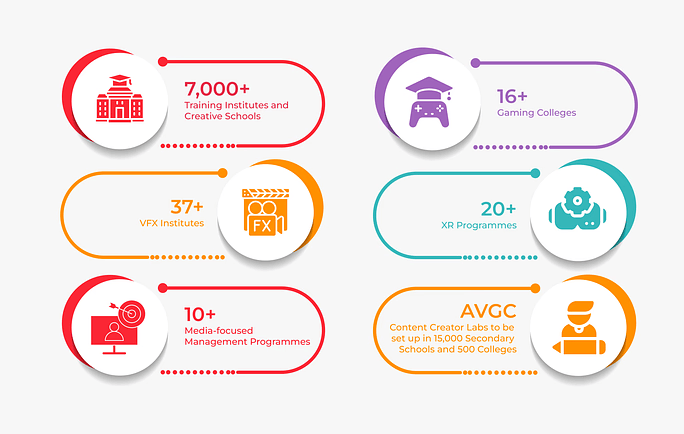
The AVGC ecosystem is witnessing structured growth through the expansion of training institutes, gaming-focused colleges, VFX academies, and immersive technology programmes such as XR. Government initiatives to establish content creator labs across 15,000 schools and 500 colleges indicate a long-term policy push toward digital creativity and applied design skills.
This expansion is expected to strengthen the talent pipeline for sectors like animation production, game design, virtual reality experiences, digital media management, and creative technology entrepreneurship. As a result, design students are likely to benefit from improved industry readiness, specialised skill training, and diversified career pathways within India’s fast-growing creative economy.
See If You’re Made for Design – Take the Design Aptitude Test
Start the TestBefore vs After Union Budget Shift in Design Opportunities
| Earlier Scenario | Post-Budget Focus |
|---|---|
| Limited infrastructure expansion | New NID campus announced |
| Focus on institute-level scholarships | Ecosystem-level skill reform |
| Fragmented AVGC support | AVGC creator labs in 15,000 schools |
| Minimal startup ecosystem emphasis | Orange Economy cluster backing |
| Fee-waiver dependent access | Infrastructure + employability model |
Top Career Sectors for Design Graduates Supported by Government Schemes and Policies
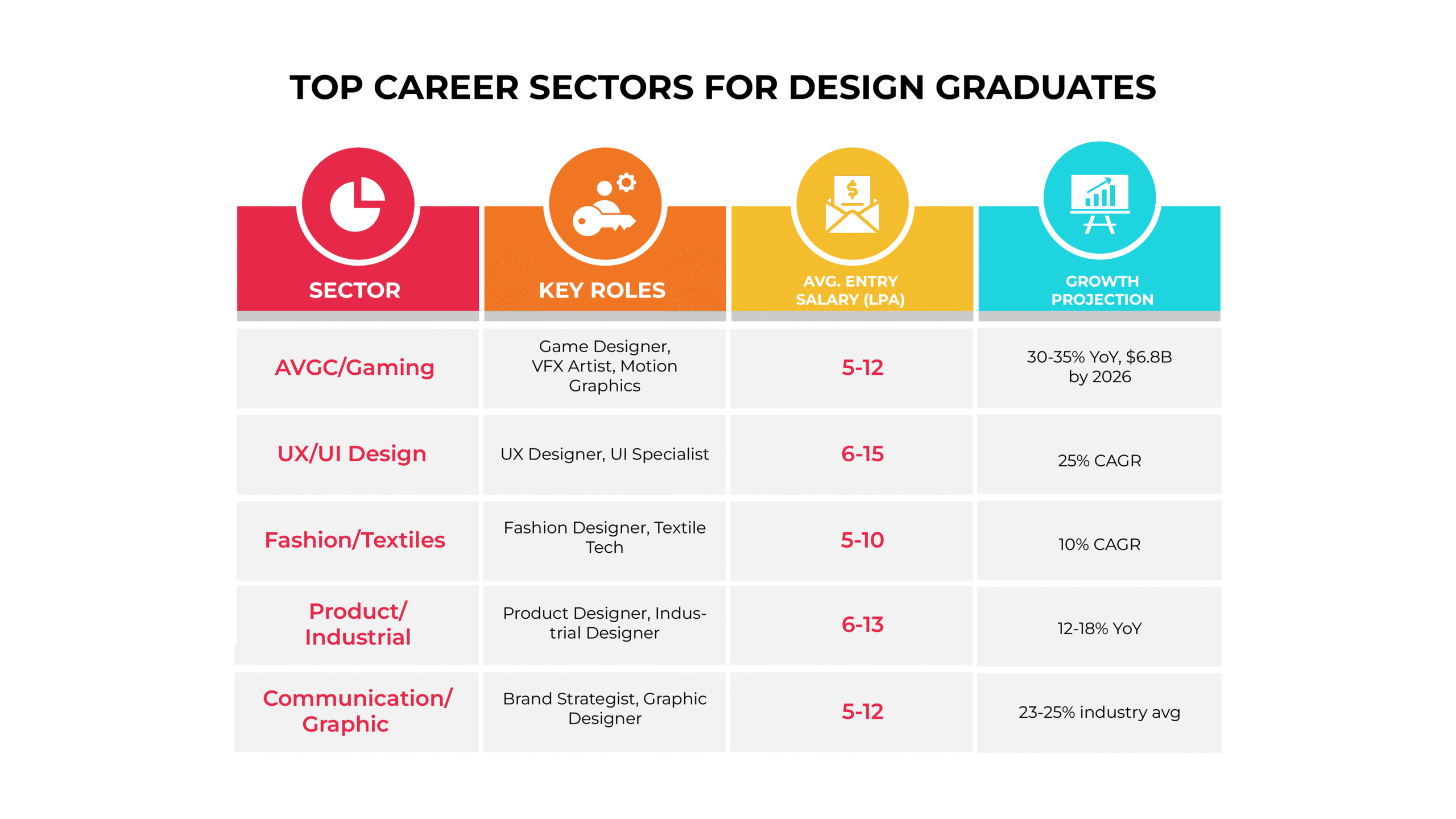
The demand for design graduates is rising across emerging creative and technology-driven sectors. Fields such as AVGC and gaming, UX/UI design, fashion technology, product design, and communication design offer strong career opportunities with competitive starting salaries and steady industry growth. For students exploring how to start fashion designing, these expanding industry pathways provide practical entry points through specialised courses, internships, and digital skill development. With increasing digital adoption and industry integration, design professionals are expected to play a key role in shaping India’s creative economy.
High Demand Careers:
India’s design graduates are finding high–demand careers across booming sectors like AVGC (Animation, VFX, Gaming, Comics), fashion/textiles, UX/UI, product/industrial design, and communication/graphic design, driven by 23–25% annual industry growth and projections of $6.8B AVGC market by 2026. UX/UI leads with 6–15 LPA entry salaries due to tech/e–commerce demand, while AVGC roles (motion graphics, game design) offer 5–12 LPA amid Orange Economy expansion. Fashion/textile and product design follow at 5–10 LPA and 6–13 LPA respectively, fuelled by exports and sustainable innovation, creating millions of jobs per CII and NITI Aayog reports.
Conclusion
In summary, schemes and policies for design students under Union Budget 2026 focus more on structural ecosystem reform than direct tuition relief. Financial, skill-based, startup, and policy-level interventions aim to build long-term capacity in India’s creative sector and strengthen the overall ecosystem for every design school in India.
While scholarships remain largely institutional rather than budget-specific, infrastructure expansion and skill integration signal stronger institutional backing. As design becomes central to India’s creative economy, sustained policy direction will determine how effectively students from each design school in India transition from classrooms to global markets
FAQs
1. What are the main schemes and policies for design students?
They include merit–based scholarships at NID and NIFT, post–matric scholarships for SC/ST/OBC students, income–based waivers like Sarthak, and startup support under creative economy initiatives. Most operate through institutional or national scholarship portals.
2. How does Union Budget 2026 support design education?
Union Budget 2026 focuses on infrastructure, AVGC labs, skill ministry expansion, and creative startup ecosystems. It does not introduce new exclusive tuition subsidies but strengthens long–term institutional capacity.
3. What is the national design policy?
The national design policy is a framework aimed at integrating design into economic growth, innovation, intellectual property development, and global competitiveness. It promotes design education, industry collaboration, and research alignment.
4. Are there government schemes for design students in India?
Yes. Existing government schemes for design students include merit scholarships at NID, post–matric scholarships via National Scholarship Portal, AICTE programs, and income–based fee waivers.
5. How can students apply for financial support?
Students can apply through the National Scholarship Portal, institute–specific merit programs, Vidya Lakshmi Portal for education loans, and income–based waiver schemes by submitting entrance rank and income documentation.
