
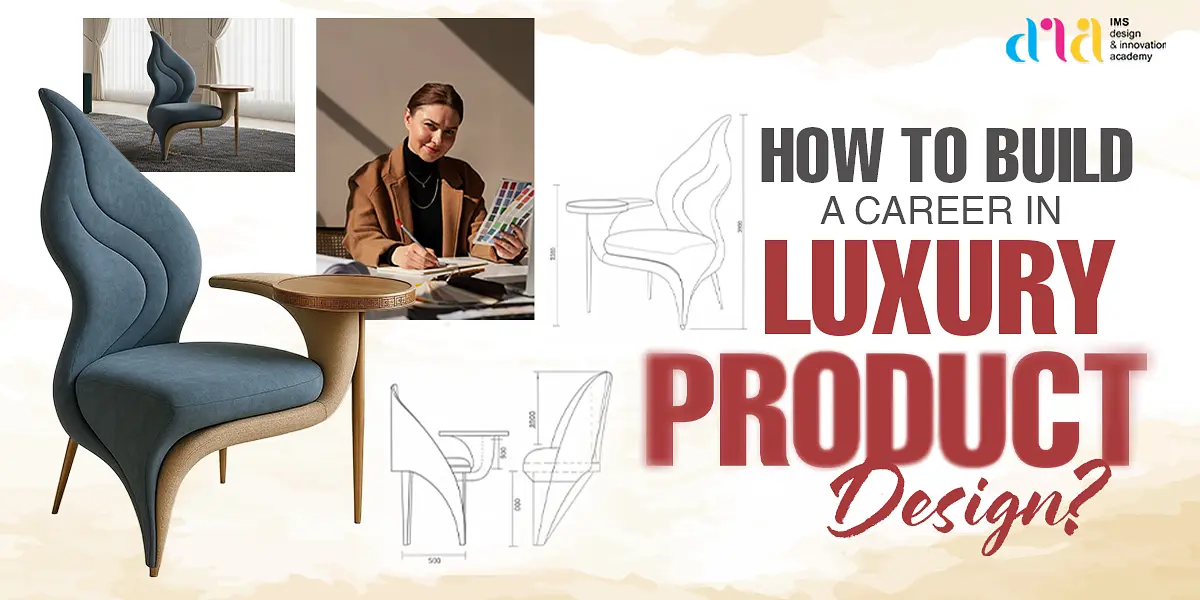
Luxury Product Design is about creating objects that go beyond basic function. It focuses on exclusivity, craftsmanship, emotional value, and strong brand identity. If you are looking to build a career in luxury product design, you are in the right place.
India’s luxury goods market is valued at USD 23.16 billion in 2025 and is expected to grow at a CAGR of 5.96% through 2030 and that growth is creating real, high-paying opportunities for designers who understand premium materials, brand storytelling, and high-net-worth consumer psychology.
This guide covers everything you need to know: what luxury product design really involves, how it differs from regular design, which courses and luxury product design institute to choose, how to build a portfolio that luxury brands actually want, and what salaries look like at every career stage in India.
What is Luxury Product Design?
Luxury Product Design is a specialised area of product design focused on creating high-value objects defined by quality, craftsmanship, and emotional appeal. Unlike mass-market product design, luxury design is not driven by scale or cost optimisation, it is driven by refinement, storytelling, and brand identity.
Think premium furniture, high-end accessories, jewellery, luxury automobiles, or bespoke lifestyle products that are made to last generations, not just seasons. These are products designed with intention, where material, form, craftsmanship, and brand story matter just as much as usability.
In simple terms: luxury product designers do not just make things. They create meaning.
Luxury Product Design vs Regular Product Design
Understanding this difference is the first step in choosing the right career path. Here is how the two disciplines compare:
| Basis | Regular Product Design | Luxury Product Design |
|---|---|---|
| Production Approach | Focuses on mass production | Focuses on limited or bespoke production |
| Pricing Strategy | Prioritises affordability | Prioritises exclusivity and premium pricing |
| Target Market | Broad consumer base | Niche, high-end clientele (HNIs and UHNIs) |
| Brand Perception | Functional and utility-driven | Strong emphasis on brand prestige and heritage |
| Emotional Value | Limited emotional storytelling | Deep emotional connection and cultural narrative |
| Material Selection | Cost-effective, widely available materials | Fine metals, rare woods, leather, ceramics, advanced composites |
| Brand Positioning | Market competitiveness and accessibility | Strong alignment with heritage, culture, identity, and status |
| Career Earning Potential | ₹4-18 LPA (mid-range) | ₹8-25 LPA+ with international exposure |
Luxury product design combines design thinking with craftsmanship and brand strategy, making it a distinct and demanding creative discipline.
Get Started Today: Our Counselors are Just a Click Away
Get a Call BackWhy Choose a Career in Luxury Product Design in India?
India ranks among the fastest-growing luxury markets globally, recording 10% growth, with projections driven by the rising number of wealthy individuals, growing urbanisation, and increased appetite for premium goods and experiences.
In 2025, luxury goods in India demonstrated strong growth driven by increasing disposable incomes, an expanding aspirational middle class, and a growing number of high-net-worth individuals, with Millennials and Gen Z significantly shaping demand by prioritising lifestyle alignment, sustainability, and authenticity in their luxury choices.
This directly translates into designer demand. Brands across jewellery, furniture, automobiles, fashion, and lifestyle products are actively looking for professionals who understand premium materials, brand storytelling, and luxury consumer psychology. That combination of skills is rare and rare skills command premium salaries.
Why a luxury product design career makes sense in 2026:
- Growing luxury consumer market across India’s metros and tier-1 cities
- Higher earning potential compared to mass-market design roles
- Opportunities to work with global brands, premium studios, and Indian luxury houses
- Exposure to advanced manufacturing, fine materials, and traditional craftsmanship
- Low competition for luxury-specialised graduates, as the supply of qualified designers is still far behind demand
Career application areas:
- Luxury fashion and accessories
- Premium furniture and lighting
- Jewellery and wearable luxury
- Luxury automobiles and mobility design
- High-end lifestyle and home brands
Step-by-Step Guide to Building a Career in Luxury Product Design
Step 1: Choose the Right Educational Foundation
Most designers begin with a Bachelor of Product Design or B Des Product Design. These 4-year undergraduate programs build a strong foundation in design fundamentals, materials science, ergonomics, manufacturing processes, and visual communication, which is everything a luxury designer needs to work with premium products and demanding brands. Students interested in luxury fashion and global exposure can also consider a Diploma in Fashion Designing with London Fashion Week exposure, which combines design fundamentals with real runway experience.
Education options available:
| Course | Duration | Eligibility | Average Annual Fees |
|---|---|---|---|
| B Des Product Design | 4 Years | 12th Pass (any stream) | Rs. 3 to 8 Lakh |
| Diploma in Product Design | 1 to 2 Years | 10+2 | Rs. 1 to 4 Lakh |
| Masters in Product Design | 2 Years | Graduation | Rs. 4 to 10 Lakh |
| Luxury Design Certification | 3 to 6 Months | Any degree | Rs. 50k to 2 Lakh |
One thing many students miss: you do not need a science or mathematics background for B Des Product Design. Students from arts, commerce, and science streams are all eligible. Selection is based on design aptitude tests, not board subjects.
When evaluating product design courses in India, also explore schemes and policies for design students that can reduce financial burden and provide scholarships or funding support. Review studio culture, faculty experience, industry tie-ups, and whether the program gives you hands-on access to premium materials and real brand projects.
Step 2: Crack the Right Entrance Exam
Getting into a top product design college in India is competitive. Most institutions require a design aptitude test that assesses visual thinking, creative problem-solving, and material sensitivity.
| Exam | Conducted By | Colleges It Covers |
|---|---|---|
| IMS DIA DET | IMS DIA | All IMS DIA Schools |
| NID DAT | NID Ahmedabad | All NID campuses across India |
| NIFT Entrance Test | NIFT | All NIFT campuses |
| CEED | IIT Bombay | M Des admissions at IITs |
| Pearl Academy Entrance | Pearl Academy | All Pearl Academy campuses |
For luxury design specifically, several private institutes also conduct portfolio-based admissions that assess your aesthetic sensibility and creative thinking directly.
Step 3: Choose the Best Product Design College in India
Your college shapes your network, your portfolio opportunities, and your early career trajectory. In luxury design especially, where brand relationships and studio connections matter enormously, where you study can define where you start.
Top product design colleges in India to consider:
| College | Location | Known For |
|---|---|---|
| NID Ahmedabad | Ahmedabad | India’s most prestigious design institution |
| IIT Bombay (IDC) | Mumbai | Industrial and product design excellence, top placements |
| Pearl Academy | Delhi, Mumbai, Jaipur | Industry-integrated luxury, fashion, and premium design |
| Srishti Manipal Institute | Bengaluru | Studio-led, experimental design education |
| MIT Institute of Design | Pune | Strong industry connections in product and industrial design |
| IIAD | Delhi | Premium product design and spatial design focus |
What to check beyond rankings: placement records with premium brands, faculty credentials, studio infrastructure, access to material labs, and whether alumni work in luxury-adjacent industries.
Step 4: Build a Luxury-Focused Portfolio
In luxury product design, your portfolio is not just a collection of finished work. It is the story of how you think.
You do not need many projects. You need a few that prove you can solve real problems with clear outcomes, as a strong portfolio with internship experience and research depth accelerates your first role and your early career trajectory.
What a strong luxury design portfolio must include:
- Concept development pages with sketches, early-stage ideation, and rough thinking
- Material studies that explain why specific materials were chosen and how they reflect the brand’s identity
- Mood boards and cultural references that demonstrate aesthetic sensitivity
- Process documentation showing the journey from brief to final resolution, not just the end result
- Brand alignment sections showing how the product fits within a specific luxury brand’s world
- Final 3D renders and physical prototypes where available
What separates a luxury portfolio from a regular one is this: regular portfolios show what was made. Luxury portfolios show why every decision was made. Craftsmanship is intentional. Materials are chosen with meaning. Form follows brand story, not just function. Luxury brands look for designers who can communicate meaning, not just form.
Essential tools to learn:
- 3D modelling: Rhino, SolidWorks, Fusion 360
- Rendering: KeyShot, V-Ray
- Concept and branding: Adobe Illustrator, Figma
- Mood boarding: Midjourney, Adobe InDesign, along with some of the top AI tools for designers that help speed up ideation and concept development
Step 5: Gain Real Industry Exposure
Luxury brands do not hire from CVs alone. They hire from studios, internships, competitions, and referrals. Industry exposure from Year 2 of your degree is non-negotiable.
Ways to build exposure:
- Internships with luxury brands, premium studios, or design consultancies
- Design competitions both national (NID, NIFT) and international (Red Dot, iF Design Award, James Dyson Award)
- Trade fairs and exhibitions such as India Design ID, Milan Design Week, and emerging tech-driven events like the 2026 AI summit in Delhi help designers stay updated with future trends
- Freelance luxury projects by approaching boutique brands, artisan collectives, and premium furniture studios
- Workshops in traditional Indian crafts, as understanding heritage craft gives you a rare and distinctive edge in luxury design
Indian brands that hire luxury product designers: Titan Company, Tata Motors Design Studio, Godrej Interio, Raymond, Forest Essentials, Amrapali Jewels, Fabindia (home and lifestyle), and a growing wave of new-age premium D2C brands.
What Skills Are Required for Luxury Product Design?
To succeed in luxury design, technical skill alone is not enough. The best luxury designers combine craft, brand intelligence, and cultural sensitivity.
Core skills you need:
- Strong design thinking and problem-solving for high-value consumers
- High aesthetic sensitivity and understanding of what premium looks, feels, and communicates
- Deep knowledge of premium materials and finishes including fine metals, rare woods, leather, and ceramics
- Understanding of high-net-worth consumer psychology
- 3D modelling and visualisation proficiency in tools like Rhino, SolidWorks, and KeyShot
- Branding and marketing awareness including knowing how a product lives within a brand’s identity
- Storytelling and the ability to explain why every design decision was made
- Sustainability thinking, which is increasingly important for globally-minded luxury consumers
Career Opportunities and Salary in India - 2026 Data
One of the most asked questions about this career. Here is the current salary picture backed by 2026 data.
Entry-level product designers in India earn between Rs. 4 to 8 LPA, mid-level professionals with 3 to 5 years of experience earn Rs. 10 to 18 LPA, and senior designers with substantial experience earn between Rs. 18 to 25 LPA, with the average settling around Rs. 20 LPA.
For luxury-specific roles, niche expertise pushes salaries above the general product design range:
| Job Role | Experience | Average Salary (India) |
|---|---|---|
| Junior Luxury Product Designer | 0 to 2 Years | Rs. 4 to 8 LPA |
| Mid-Level Luxury Designer | 2 to 5 Years | Rs. 10 to 18 LPA |
| Senior Luxury Designer / Design Lead | 5 to 8 Years | Rs. 18 to 28 LPA |
| Creative Director (Luxury Brand) | 8+ Years | Rs. 25 to 50 LPA and above |
| Freelance Luxury Design Consultant | Variable | Rs. 6 to 20 LPA (project-based) |
City-wise salary overview:
Bengaluru leads with an average product designer salary of Rs. 10 LPA, followed by Mumbai at Rs. 7.5 LPA and Delhi at Rs. 7 LPA. For luxury-specific roles, Mumbai has the highest upside given the concentration of luxury fashion houses, premium studios, and high-net-worth clientele.
With the right guidance, strong industry exposure, and meaningful internships, freshers can secure higher packages. Compensation increases significantly with experience, brand associations, and a well-developed portfolio. Working on international projects and collaborating with global studios can unlock even greater earning potential over time.
Product Design Courses Fees in India
| Institution Type | Fee Range | Details |
|---|---|---|
| Government Colleges (NID, IITs) | Rs. 1 to 3 Lakh | Annual total fees |
| Private Colleges | Rs. 3 to 8 Lakh | Annual total fees |
| International Institutes | Rs. 10 Lakh and above | Annual tuition fees |
See If You’re Made for Design - Take the Design Aptitude Test
Start the TestIs Luxury Product Design the Right Career for You?
Luxury Product Design is suited for those who value detail, craftsmanship, and thoughtful creation. Ask yourself these questions before deciding:
- Do you care deeply about how things are made, not just what they look like?
- Are you drawn to materials, heritage, and the stories behind objects?
- Do you prefer creating one exceptional thing over a hundred ordinary ones?
- Are you comfortable designing for an audience that values meaning over price point?
If your answers lean yes, this field is built for you.
With the right education such as a B Des Product Design or Bachelor of Product Design, a focused portfolio, and meaningful industry exposure, designers can build globally relevant careers in luxury. The field offers strong salary growth, international opportunities, creative depth, and the satisfaction of making things that genuinely last. Research product design schools in India, evaluate programs carefully, and take the first step toward a career in Luxury Product Design.
FAQs
Q1. What qualifications are required for Luxury Product Design?
A recognised product design degree, diploma, or certification paired with a strong portfolio is the standard entry point. A B Des Product Design from a reputed institution is the most common qualification. Supplementary certifications in luxury brand management or advanced materials science can further strengthen your profile.
Q2 Which are the best product design courses in India?
The B Des Product Design is the most recommended 4-year undergraduate path. Top institutions offering strong programs include NID Ahmedabad, IIT Bombay’s Industrial Design Centre, Pearl Academy, Srishti Manipal Institute, and MIT Institute of Design, Pune. Each has different strengths in terms of industry integration, studio culture, and luxury-adjacent placements.
Q3. What is the salary of a Luxury Product Designer in India?
Entry-level roles start at Rs. 4 to 8 LPA, mid-level designers with 2 to 5 years of experience typically earn Rs. 8 to 18 LPA, and senior designers move into Rs. 16 to 34 LPA as their scope expands. Creative Directors at luxury brands can earn Rs. 25 to 50 LPA and above, particularly with international brand exposure.
Q4. Is mathematics required for product design courses in India?
No. B Des Product Design is open to students from all streams including science, commerce, and arts. Admissions are based on design aptitude tests like IMS DIA DET or NID DAT along with portfolio reviews, not board subjects or mathematics scores.
Q5. What software tools are used in Luxury Product Design?
The most widely used tools include Rhino and SolidWorks for 3D modelling, KeyShot and V-Ray for photorealistic rendering, Figma and Adobe Illustrator for concept development and branding, and Midjourney or Adobe InDesign for mood boarding. Hand sketching remains a highly valued skill in luxury design, where material intuition and craft sensitivity are just as important as digital output.

