
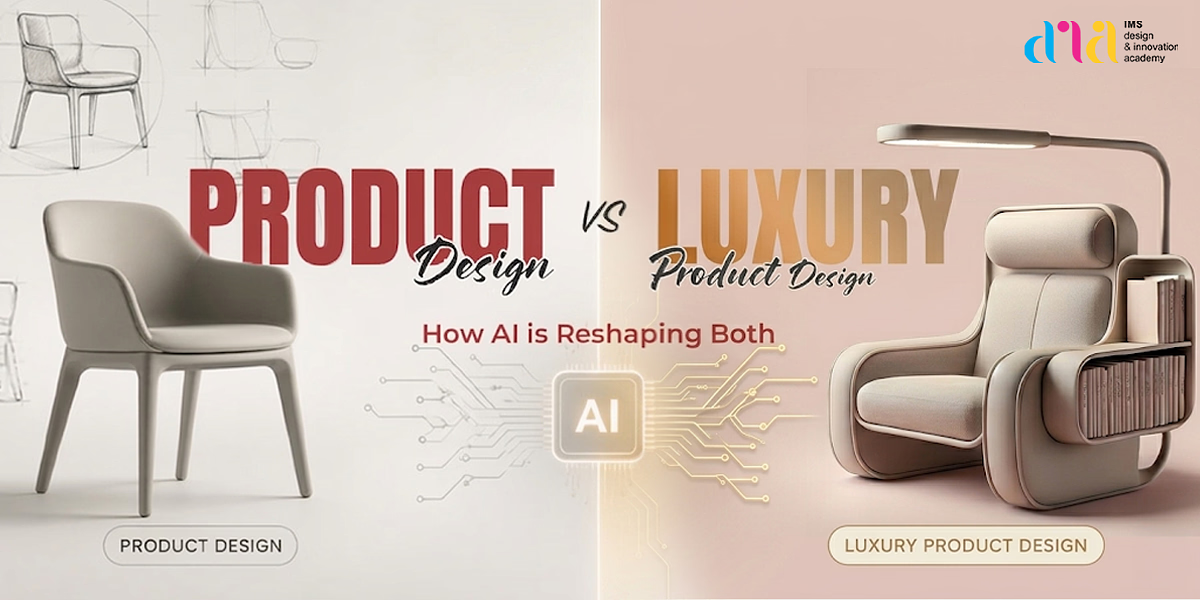
The design industry is currently split into two distinct paths: creating for everyone and creating for the few. While standard product design solves functional problems for millions, luxury product design focuses on rarity and emotional connection. Artificial intelligence is now integrated into both, but the ways you use it in these two sectors are fundamentally different. This shift is also influencing how students choose specialized education paths, especially at leading luxury product design colleges in Noida, where AI-driven design thinking, innovation, and premium brand strategy are becoming essential parts of the curriculum.
What is Product Design?
Product Design is the strategic and holistic process of creating solutions that solve specific user problems while meeting business goals. It is far more than just “making things look good”; it encompasses the entire lifecycle of a product from identifying a gap in the market to research, prototyping, and final production.
In modern contexts, product design covers both physical goods (like a chair or a smartphone) and digital products (like a mobile app or software interface).
What is Luxury Product Design?
Luxury product design focuses on crafting high-value objects through exceptional craftsmanship and premium materials. While utility is a factor, this discipline uses storytelling, craft, history, and emotional connection with the user. By emphasizing heritage, exclusivity, and meticulous detail, luxury design signals status and favors artisanal mastery over mass-produced methods. With the growing global demand for premium experiences and bespoke creations, pursuing a career in luxury product design offers exciting opportunities in industries such as jewellery, fashion, automotive, furniture, and lifestyle accessories.
Product Design vs Luxury Product Design: The Core Differences
| Metric | Standard Product Design | Luxury Product Design |
|---|---|---|
| Primary Goal | Problem-solving and utility | Status, heritage, and emotional appeal |
| User Base | General consumers | High-net-worth individuals |
| Material Choice | Affordable, recyclable, or durable materials | Rare, precious, or artisanal materials |
| Production Volume | Mass production (millions of units) | Limited editions or bespoke production |
| AI Application | Structural optimization and functionality enhancement | Personalization, exclusivity, and aging simulation |
| Key Success Metric | Price-to-performance ratio | Brand equity, exclusivity, and rarity value |
Get Started Today: Our Counselors are Just a Click Away
Get a Call BackHow AI is Reshaping Both Product Design & Luxury Product Design
AI in Product Design
In standard design, AI acts as a technical assistant. You use it to cut costs and improve performance.
- Generative Engineering: Designers use tools like Autodesk or Pave to input parameters like “minimum weight” and “maximum stress.” The AI then creates thousands of structural variations. You choose the one that uses the least plastic while maintaining strength.
- Rapid Prototyping: AI-driven software can simulate how a product will perform in a wind tunnel or a crash test. This allows you to skip three or four physical prototype stages, saving months of work.
- Supply Chain Optimization: AI predicts which materials will be cheapest in six months, helping you decide whether to use aluminum or high-grade polymer for a laptop chassis.
AI in Luxury Product Design
Luxury brands use AI differently. They do not care about saving five cents on a screw; they care about making the buyer feel unique. That is why many premium brands now use personalization engines, virtual prototyping, and the 10 AI tools for designers to create exclusive products, custom experiences, and emotionally driven luxury design concepts.
- Hyper-Personalization: Brands like Ferrari use AI to help customers visualize millions of colors and trim combinations. The AI ensures that no two cars look exactly alike while maintaining the brand’s specific aesthetic rules.
- Material Simulation: Luxury designers use AI to simulate how a specific cut of leather or a gold alloy will look after twenty years of use. This ensures the product remains “perfect” as it ages.
- Virtual Ateliers: AI allows a client in Tokyo to work with a designer in Paris. The AI translates the client’s verbal descriptions of a “mood” into high-fidelity 3D renders in real-time.
Why AI is Becoming Essential in Modern Design
Market cycles move fast. You can use AI in product design to reduce overall development time by 50%. In 2026, companies adopting these systems report a 30% faster path from concept to store shelves. This speed allows you to respond to sudden consumer needs in days. You no longer wait months for a prototype. You generate a digital version, test it, and move to production immediately. These innovations are also becoming a major discussion point at the 2026 AI Summit in Delhi, where brands and technology leaders are exploring how AI is transforming product development across industries.
Personalization used to be a manual, high-cost service. Now, it is a standard expectation.
- AI in Luxury Product Design allows you to offer this to every customer.
- High-end brands use analytics to identify personal tastes.
- They match these tastes with specific products in real time.
- 70% of current buyers expect you to understand their specific needs without being asked.
Material Efficiency and Sustainability
Sustainability is a legal and social requirement. AI algorithms reduce material waste by 15% to 20% through optimized manufacturing patterns. In 2026, brands use Digital Product Passports to track every material. These tools document where a product comes from and what it contains. You do this at scale without adding massive manual labor costs.
Real-World Examples of AI in Product and Luxury Brands
1. Nike: Cutting the Fat with Algorithms
Nike doesn’t just have designers sketching shoes anymore. They use generative design essentially giving a computer a set of rules (like “make it light but don’t let it snap”) and letting it run millions of simulations. The AI found that by using a lattice structure instead of a solid block of foam, they could strip away 15% of the material. It looks like a spiderweb, but it performs better than a solid sole. It’s a win for Nike because it cuts manufacturing costs, and a win for athletes who want a lighter shoe that doesn’t lose its bounce.
2. Rolls-Royce: Seats that "Know" You
In Rolls-Royce, luxury is about removing every possible discomfort. They’ve integrated AI that acts like a digital tailor for your spine. Sensors in the car track how you sit and how your weight shifts as you drive. The AI isn’t just recording data; it’s actively telling the seat’s internal foam and leather to tighten or loosen. If you’re leaning too much to the left or getting stiff on a long trip, the seat adjusts itself to maintain that “floating” feeling. It turns a static chair into a reactive piece of technology that fits your body perfectly every single time.
3. LVMH: AI as a Digital Detective
For LVMH, the biggest threat is the growing counterfeit market and the lack of transparency in global supply chains. To tackle this, the company uses AI-powered systems with the Aura Blockchain, which works like a digital birth certificate for luxury products such as handbags, watches, and designer accessories. The AI studies microscopic leather grains, stitching patterns, and fabric weaves that are impossible for the human eye to track consistently. This creates a unique digital fingerprint for every product.
That fingerprint follows the item through every stage of production, from raw material sourcing to the boutique shelf. So, when someone buys a Louis Vuitton bag, AI has already verified whether the leather was ethically sourced, whether the craftsmanship meets luxury standards, and whether the product is completely authentic. In modern luxury, brands are no longer just selling products. They are selling trust, traceability, and exclusivity.
This shift is also changing the future of industrial and luxury innovation, which is why many students researching how to become a product designer are now learning about AI, blockchain verification, material intelligence, and smart manufacturing alongside traditional design skills.
Challenges of AI in Design Industries
1. The Homogenization Trap
If every designer uses the same AI models trained on the same datasets, products will eventually look identical. AI favors the average. It analyzes what is popular and generates a refined version of it. This kills the radical innovations that come from human risk-taking. You risk creating a world of “Pinterest-perfect” designs that lack a unique brand voice. This is why students exploring product design courses after 12th must focus on developing original thinking, creative problem-solving, and a strong personal design identity alongside learning AI tools.
2. The Skill Gap and Reliance
New designers might lose the ability to build from scratch. If you only know how to prompt a machine, you might not understand why a specific joint in a chair fails or how a certain fabric reacts to humidity. You become a curator rather than a creator. This leaves you vulnerable when the software makes a structural error that your eye isn’t trained to catch.
3. Liability and Safety
Accountability remains a major gray area. If an AI-designed product causes an injury, the legal blame is unclear.
- The Software Developer: Did the algorithm have a flaw?
- The Designer: Did you provide a poor prompt or fail to check the math?
- The Manufacturer: Did they follow a faulty AI blueprint? In 2026, insurance companies still struggle to price these risks. If a ladder optimized by AI to be as light as possible snaps under a user, you face a legal nightmare with no clear precedent.
Confused, What to Choose between Product Design & Luxury Product Design? Talk to a counselor
Get a Call BackFuture Trends of AI in Product and Luxury Design
1. Adaptive Products
We are moving away from “one-size-fits-all” furniture. Future office chairs and apparel will embed sensors that feed data into local AI processors to change physical properties in real-time.
- The Shift: Instead of you adjusting the chair, the chair adjusts to your spinal pressure and muscle fatigue throughout the day.
- The Data: The global smart furniture market is projected to reach approximately $1.8 billion by 2027, growing at a CAGR of over 10%. This growth is driven by the demand for ergonomic, AI-integrated office solutions that prevent chronic back pain.
2. Digital Twins and Blockchain Heritage
Luxury items will no longer be isolated physical objects. High-end watches or cars will be sold with a “Digital Twin” a virtual replica that lives on a blockchain.
- The Shift: This twin tracks the item’s entire history, from the temperature it was stored at to every repair made. AI manages this ledger to predict when the physical item needs maintenance.
- The Data: Reports suggest that the blockchain in the fashion and luxury market could see an annual growth rate of 40%, as brands look to protect the $450 billion lost annually to the global counterfeit trade.
3. Automated Authentication for Pre-owned Goods
As the “circular economy” grows, brands need to verify their products even after they have changed hands five times.
- The Shift: Luxury brands are deploying computer vision AI that scans microscopic markers like the unique grain of a specific leather hide or the exact tension of a stitch pattern to instantly verify authenticity via a smartphone.
- The Data: The secondhand luxury market is expanding nearly 3x faster than the primary market. AI authentication is critical to maintaining the value of this $30+ billion resale sector.
4. Digital Product Passports (DPP)
Transparency is becoming a legal requirement. AI will manage “Product Passports” that tell the user exactly where every component came from and how to fix it.
- The Shift: Scan a QR code on a standard toaster or jacket, and the AI shows you a map of its raw materials and a step-by-step repair guide tailored to the wear-and-tear it has sustained.
- The Data: With the EU’s Ecodesign for Sustainable Products Regulation taking effect, over 80% of consumer products are expected to eventually require a Digital Product Passport to enter the European market.
Conclusion
The design industry has reached a point where manual processes alone cannot meet modern standards. AI is now a fundamental requirement. Whether you work in mass-market product design or high-end luxury, your success depends on how you direct the technology.
In the mass market, your goal is precision at scale. You use AI in Product Design to cut waste and improve performance. This makes products cheaper and more accessible for millions of people. In the luxury sector, your goal is intimacy. You use AI in Luxury Product Design to create a unique connection between a brand and a single client. This keeps the item exclusive and desirable.
Today, every leading design institute in Noida is also adapting to this shift by integrating AI tools, digital workflows, and innovation-driven learning into design education. Students are now expected to understand both creative thinking and technology-led execution to stay competitive in the industry.
The future of design centers on human-led direction supported by machine calculation. You decide the intent, and the AI handles the complexity.
FAQs
1. What is the difference between product design and luxury product design?
Standard design focuses on making things useful and affordable for many people. Luxury design focuses on making things exclusive and emotionally resonant for a few.
2. How is AI transforming product design?
It automates the boring parts. It calculates stress loads and finds the cheapest ways to build strong products quickly.
3. How are luxury brands using AI in design?
They use it to offer custom features. It helps them create “one-of-a-kind” items for wealthy clients without the slow speed of traditional manual drafting.
4. What are the benefits of AI in product and luxury design?
You get products that last longer, perform better, and waste fewer materials during the manufacturing process.
5. How does AI improve customer experience in luxury products?
It allows you to co-design your own items. You can see exactly what your custom handbag or car will look like before it is even made.
