
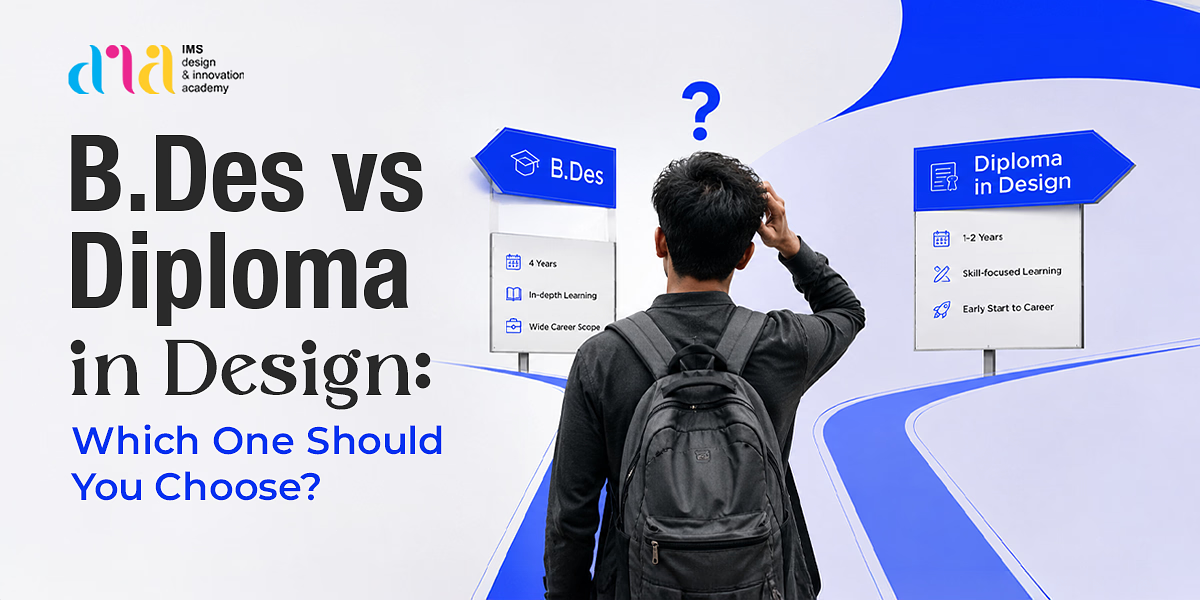
Selecting a design course involves comparing the qualification, learning depth, course duration, practical exposure, and long-term career opportunities associated with each option. For students interested in building a career in design, B.Des vs Diploma in Design is an important comparison, especially after completing Class 12.
A Bachelor of Design (B.Des) is generally a full undergraduate degree that provides structured and comprehensive design education. A diploma in design is usually shorter and more focused on developing practical skills for a particular area of design. Neither option is universally better; the right choice depends on your career goals, preferred learning approach, available time, and plans for higher education.
This article explains the difference between B.Des and diploma in design, including course structure, career scope, portfolio development, industry exposure, and factors to consider before choosing.
B.Des vs Diploma in Design: Quick Comparison
The following comparison provides a quick overview:
| Comparison Detail | B.Des | Diploma in Design |
|---|---|---|
| Eligibility | 10+2 or equivalent from a recognised board; students from any stream can apply | 10+2 or equivalent from a recognised board; eligibility requirements may vary depending on the diploma program |
| Course Duration | 4 years / 8 semesters | 1–3 years, depending on the program and institution |
| Course Type | Undergraduate degree program | Diploma or skill-focused program |
| Learning Approach | Combines design theory, research, studio learning, practical projects, and specialization | Focuses more on practical skills, tools, techniques, and application-based learning |
| Best Suited For | Students seeking comprehensive design education and broader academic and career progression | Students looking for focused skill development and a comparatively shorter route into design-related work |
What Is a B.Des Degree?
A Bachelor of Design (B.Des) is an undergraduate degree focused on design principles, creative problem-solving, research, visual communication, technology, and practical application.
Depending on the institution, students may pursue areas such as luxury product design, communication design, fashion design, animation, user experience design, or related disciplines.
B.Des programs typically combine classroom learning with studio assignments, workshops, collaborative projects, portfolio development, and industry-oriented experiences. Because the degree spans several years, students generally have more time to explore different design concepts before developing deeper expertise.
What Is a Diploma in Design?
A diploma in design is generally a shorter educational program focused on practical and job-relevant design skills. Diploma courses may be available in graphic design, fashion design, interior design, animation, UI/UX design, multimedia, and other areas.
The curriculum is often concentrated on a specific design discipline and may emphasize software, tools, techniques, studio assignments, and portfolio projects.
Diploma programs can suit students who already know which design area they want to explore or who prefer a shorter route into skill development. However, course quality, recognition, and academic progression options can differ significantly between institutions.
B.Des vs Diploma in Design: Key Differences
Understanding the main differences can help students assess which pathway aligns with their expectations.
Course Duration
A B.Des is commonly a four-year undergraduate degree. This longer duration allows students to progress from design foundations to advanced projects and specialization.
Diploma courses are generally shorter, often lasting between one and three years depending on the program and institution.
Qualification and Recognition
B.Des leads to a bachelor’s degree from a recognized degree-awarding institution. This can be relevant for roles or postgraduate programs that specifically require an undergraduate degree.
A diploma is a different type of qualification. Its recognition and academic equivalence depend on the institution, accrediting framework, and specific program.
Curriculum and Depth of Learning
A B.Des curriculum generally covers design fundamentals, research methods, design thinking, communication, technology, theory, and specialization subjects.
Diploma programs tend to concentrate on specific practical competencies. They may offer less theoretical breadth but can provide focused training in a chosen discipline.
Practical and Studio-Based Learning
Both pathways can involve hands-on learning.
B.Des programs often integrate studio practice throughout the degree through workshops, prototypes, assignments, and interdisciplinary projects. Diploma programs may provide intensive practical training designed around specific techniques, software, and professional skills.
Industry Exposure
Industry exposure may include internships, live briefs, workshops, competitions, guest sessions, or collaborative projects.
A longer B.Des program can provide multiple opportunities for such experiences. Diploma programs may also offer strong industry exposure, although this depends heavily on the institution and course structure.
Portfolio Development
A portfolio demonstrates a designer’s thinking, skills, processes, and completed work.
B.Des students may build a broader portfolio over several years, documenting research, experimentation, and advanced projects. Diploma students can develop more focused portfolios that demonstrate practical capability in a particular design area.
Career Opportunities
B.Des graduates can explore entry-level opportunities across various design disciplines based on their specialization and portfolio.
Diploma holders can also pursue design roles, particularly where practical skills and portfolio quality are key selection criteria. Individual opportunities depend on specialization, experience, employer requirements, and demonstrated capabilities.
Higher Education Opportunities
A recognized B.Des degree can provide a direct academic foundation for eligible postgraduate programs in design and related fields.
Diploma holders may also have further-study options, but admission requirements vary. Some postgraduate degree programs require applicants to hold a recognized bachelor’s degree.
Get Started Today: Our Counselors are Just a Click Away
Get a Call BackB.Des vs Diploma in Design: Career Scope
Career scope depends less on the course title alone and more on specialization, portfolio strength, practical ability, internships, communication skills, and industry requirements.
Career Options After B.Des
A B.Des degree opens pathways across multiple design disciplines, depending on a graduate’s specialization, portfolio, technical skills, and industry exposure.
The table below provides an indicative overview of common career options and salary ranges across different experience levels in India.
| Career Option | Entry Level | Mid Level | Senior Level |
|---|---|---|---|
| Product Designer | ₹7–12 LPA | ₹13–24 LPA | ₹24–40+ LPA |
| Graphic or Communication Designer | ₹2–3.5 LPA | ₹4–8 LPA | ₹8–15+ LPA |
| UI/UX Designer | ₹5–10 LPA | ₹10–18 LPA | ₹18–30+ LPA |
| Fashion Designer | ₹3–5 LPA | ₹5–8 LPA | ₹8–15+ LPA |
| Interior or Spatial Designer | ₹2.5–4 LPA | ₹5–7 LPA | ₹7.5–12+ LPA |
| Design Strategist | ₹5–8 LPA | ₹8–15 LPA | ₹15–25+ LPA |
Depending on the specialization and skills, B.Des graduates may explore roles such as:
- Product Designer: Develops physical or digital products by considering user needs, functionality, usability, materials, and overall design experience.
- Graphic or Communication Designer: Creates visual communication for brands through identities, layouts, campaigns, packaging, digital content, and other communication materials.
- UI/UX Designer: Works on websites, applications, and digital products by improving interfaces, navigation, usability, and the overall user experience.
- Fashion Designer: Develops apparel, collections, textiles, and fashion concepts while considering trends, materials, customer preferences, and market requirements.
- Interior or Spatial Designer: Plans residential, retail, hospitality, workplace, and other environments by combining spatial planning, materials, functionality, and user needs.
- Design Strategist: Connects design research, customer insights, business requirements, and problem-solving to help organizations make informed product or service decisions.
Career Options After a Diploma in Design
A Diploma in Design can prepare students for practical and execution-focused roles across different creative fields. Career growth and salary progression may vary based on specialization, portfolio quality, software proficiency, internships, and professional experience.
The table below highlights indicative salary ranges for some common career options.
| Career Option | Entry Level | Mid Level | Senior Level |
|---|---|---|---|
| Graphic Designer | ₹2–3.5 LPA | ₹4–8 LPA | ₹8–15+ LPA |
| Junior UI/UX Designer | ₹3–5 LPA | ₹5–10 LPA | ₹10–18+ LPA |
| Visual Designer | ₹3–5 LPA | ₹5–9 LPA | ₹9–15+ LPA |
| Illustrator | ₹2.5–4 LPA | ₹4–7 LPA | ₹7–12+ LPA |
| Fashion Design Assistant | ₹2–3.5 LPA | ₹3.5–6 LPA | ₹6–10+ LPA |
| Interior Design Assistant | ₹2–3.5 LPA | ₹3.5–6 LPA | ₹6–10+ LPA |
Depending on their specialization and skills, diploma students may explore roles such as:
- Graphic Designer: Creates layouts, graphics, social media assets, marketing materials, and other visual communication for brands and organizations.
- Junior UI/UX Designer: Supports interface design, wireframes, prototypes, user flows, and other elements involved in creating digital experiences.
- Visual Designer: Works with typography, imagery, layouts, and visual systems to maintain a consistent look across digital or print communication.
- Illustrator: Produces original visual artwork for publishing, advertising, branding, digital media, fashion, and other creative applications.
- Fashion Design Assistant: Supports designers with research, sketches, fabric selection, sampling, collection development, and production-related activities.
- Interior Design Assistant: Assists with layouts, material selection, drawings, presentations, site coordination, and other aspects of interior design projects.
B.Des vs Diploma in Design: Which Is Better for Different Career Goals?
The better option depends on what you expect from your design education.
Choose B.Des If You Want a Full Undergraduate Design Degree
A B.Des may be suitable if you want comprehensive undergraduate education covering design theory, research, studio practice, projects, and specialization.
The longer course structure can also provide more time to experiment with disciplines and develop a mature portfolio.
Choose a Diploma If You Want Shorter, Skill-Focused Training
A diploma may be appropriate if your priority is learning practical skills within a shorter period.
This route can be useful for students who have identified a specific design field and want concentrated training rather than a broader undergraduate curriculum.
Choose B.Des If You Plan to Pursue Higher Studies
If postgraduate education is an important long-term goal, a B.Des can provide a clearer academic pathway because it is a bachelor’s degree.
Students considering a diploma should check the admission requirements of future postgraduate programs before making a decision.
Ready to Take Admission in Top Fashion Design College?Get Admission Guidance
Get Admission HelpB.Des vs Diploma in Design: Which One Is Right After 12th?
After Class 12, the decision should reflect your long-term plans rather than course duration alone.
A B.Des may make sense for students who want a full undergraduate qualification and several years of structured design education. It can provide broader exposure to design concepts, research, studio practice, and specialization.
A diploma may suit students who want to develop specific design skills in a shorter timeframe or explore a particular discipline before making longer-term academic decisions.
Before applying, compare eligibility requirements, curriculum, faculty, infrastructure, portfolio opportunities, internships, recognition, and progression pathways.
How to Choose the Right Design Course
Choosing between B.Des and a diploma in design requires evaluating both immediate learning needs and future career plans.
Check the Curriculum
Review the subjects instead of relying only on the course name. Look for design fundamentals, relevant tools, research, studio assignments, specialization modules, and project–based learning.
Compare Course Duration and Learning Depth
Consider how much time you can commit to formal education. A longer B.Des generally offers greater breadth and progression, while a diploma can provide concentrated skill development within a shorter timeframe.
Evaluate Industry Exposure
Check whether the program provides internships, live projects, industry mentorship, workshops, guest lectures, or professional collaborations. These experiences can help connect classroom learning with real design requirements.
Check Portfolio and Project Opportunities
Review how many individual and collaborative projects students complete. A good course should provide opportunities to document research, design processes, experimentation, and final outcomes–not simply software proficiency.
Consider Long-Term Career Goals
Think beyond your first job. If your goals include postgraduate education, interdisciplinary design roles, research, or positions requiring an undergraduate qualification, a B.Des may provide a suitable foundation.
If your immediate priority is focused skill development and entry into a specific design area, a diploma may be worth considering.
Conclusion
The B.Des vs Diploma in Design decision should be based on qualification level, curriculum depth, practical exposure, portfolio opportunities, course duration, and long-term academic and career requirements.
A B.Des generally suits students seeking a comprehensive undergraduate design education and a pathway that can support postgraduate study. A diploma can suit learners who prefer shorter, specialized, and practical training.
Before choosing either option, compare the curriculum, institutional recognition, faculty expertise, studio facilities, industry exposure, graduate portfolios, and eligibility for future study. The right course is the one that aligns most closely with the design skills you want to develop and the qualifications your intended career path requires.
FAQs
Is B.Des better than a diploma in design?
B.Des offers broader undergraduate education, while a diploma provides shorter, skill–focused training. The better choice depends on individual career goals.
Can I pursue B.Des after completing a diploma in design?
Yes, you may pursue B.Des after a diploma, provided you meet the eligibility and admission requirements specified by the institution.
Is a diploma in design enough to get a job?
A design diploma can support entry–level opportunities when combined with relevant practical skills, industry exposure, and a strong professional portfolio.
Which is better after 12th, B.Des or diploma?
B.Des suits students seeking comprehensive undergraduate education, while a diploma may suit those preferring shorter, specialized, and practical design training.
Does B.Des offer better career opportunities than a diploma?
B.Des may provide broader career pathways, while diploma opportunities often depend on specialization, portfolio quality, practical skills, and employer requirements.
